Showing posts with label the explication of that which had been heretofore unknown. Show all posts

Monday, April 25, 2011

A Quaintly Titled Demon, and Other Lexicographical Curiosities

In Which we Once Again Set Sail Upon the Seas of Strange Sayings and Quizzical Terms, for Purposes of Perhaps Enriching the Common Vocabulary of Today Amongst all Who Lay Eyes Upon the Screed

Today we shall go off upon yet another excursion into one of my favorite subjects, that of the long-winded explanation of supposedly commonplace words and phrases of which neither I nor anyone I have ever met have even the slightest hint of familiarity with. I must apologize for the brevity of my introduction today, but I fear that there is more than a modest whiff of ennui emanating from my soul today, and I would fain avoid infecting you, my dear readers, with said taint, as would surely occur, were I to prolong this introduction beyond the scope of performing its mere duty as providing the sparsest of context for what shall follow. Thus with no further ado, let us rejoice in this mild exaltation in obscurity!

Pudding and Tame, familiar to most of us because of a children's chant beginning with those words, has religious associations. It is, according to the Opies' The Lore and Language of School Children, "the name of the fiend or devil 'Pudding of Tame' listed in Harnet's Popish Impostures," published way back in Shakespeare's time. The devilish implications of the name have long since been forgotten by the children who cheerfully chant: "What's my name, Puddin' and Tame. Ask me again and I'll tell you the same." Curiously enough, although the original name is English, the children's rhyme is said to have originated in Maryland. Wentworth's American Dialect Dictionary reports it as turning up all over the country-Arkansas, Mississippi, New York State, and Heaven (or the devil) only knows where else.

Spizzerinctum. This oddity from rural dialect [was previously discussed] and we mentioned that dictionaries define it as cold cash or hard money. The question that led to our discussing this word involved a minister who exhorted his followers to deliver more spizzerinctum. We implied that he was looking for a better-filled collection plate, but a West Virginian reader thought otherwise. "In this area," she writes, "the old people use the word to mean energy and enthusiasm. They say things like 'I wish I had his spizzerinctum,' when speaking about a young person. Undoubtedly this is how the minister meant the word. If you had attended an old time revival meeting in my neck of the woods, you would know that joy, energy, and enthusiasm= are much more in abundance (and much more desired) than cold cash!'"

Welsh Rabbit/Rarebit (which the more observant amongst us will recognize from a previous column). A widely held misconception is that Welsh Rabbit is a vulgar form of Welsh rarebit. Actually the opposite is true, for Welsh rarebit is merely a mannered and affected corruption of a phrase that dates back nearly to Shakespeare's time. In those days only the wealthy in Wales could afford game from royal preserves. So since rabbit itself was such a rarity, melted cheese on toast became known semi-humorously as Welsh rabbit. In a similar fashion, scrambled eggs on toast spread with anchovy butter came to be called Scotch Woodcock. Up in New England today, you may occasionally hear codfish called Cape Cod turkey. It's unfortunate that the editors of some cookbooks have helped to spread the nice-nellyism rarebit. Perhaps it's because the term has long been a favorite of restaurant menu writers-a curious breed who seem never to be able to say anything simply. H. W. Fowler, as usual, has a brusque and trenchant commentary on the manner. "Welsh rabbit," he writes, "is amusing and right, and Welsh rarebit stupid and wrong."

One more stitch in the wildcat's tail. This odd expression comes to our attention in a note from a reader who said that his grandmother, after finishing a difficult job, would say: "Well that's one more stitch in the wildcat's tail." We asked our column readers if any could tell us more about the expression, and Frank Flanagan obliged. He wrote: "My late father, God rest his merry soul, would now and then come home smelling of strong drink and with a yen to sing. He had a very good voice, and he could really belt out his favorite songs. One of them went like this, to my Jewish mother's disgust:
'Way down south in St. Augustine,
a wildcat jumped on a sewing machine.
The sewing machine was going so fast
It took 44 stitches in the wildcat's...'
Maybe the lady made a slight change in her version."

Thursday, March 31, 2011

A Footnote in the History of Swindlery

In Which Crimes Against Both Humanity and Livestock are Regaled for One's Lazy Thursday Perusal

In days of yore upon the Isle of Albion, the scourge of Bird-Swindlers wreaked havoc on hopeful gift-givers, whether they be for one's nephew's saints day celebration, a way of apology to one's spouse, or for sly seduction of a fair serving wench. The occupation of Bird-Swindler involved ensnaring some local common English avian, something along the lines of a Finch or Sparrow, and then with the aids of scissors, dyes, and modified prosthetic feathers, modifying the appearance of the bird in such a way as to trick potential customers into believing that they have in front of them some rare breed of The Bird of Paradise itself. Bird-swindlery was far from the only animal related crime in England at the time, a perusal of court dockets from the past reveals numerous and original malfeasances such as fox riggery, selling a man oats intended for cattle, calculating the horoscope of an ass, wasp divination, impersonating the cry of a cuckoo, poaching the queen's cod, and introducing an eel into the anus of a horse.

Tuesday, March 29, 2011

A Garden Path Through a Confused Grammarian's Lexicon

Whilst today one can select from the theories of Stochastic Processes, Con-Spiracies of varying degrees of malevolence, Chaotic Dynamics, or simply pure Nihilism in order to explain away the seemingly un-caring randomness of the universe, in ancient days Men had contrived Deities whose purposes seemed to be divine emodiments of capricious urges and malicious pranks1. The Norse painted their trickster god as alternately a figure of malicious rage, a cunning techno-logy innovator, or a mischievous relief side kick3; While the Coyote figure in many native american stories apprehends a more hapless stance, acting typically out of selfish urges and often suffering many comical slapstick mis-fortunes as a result of his deceits5.

The point being, that in order to console ourselves with various aspects of un-predictability, it is often helpful to Name this phenomona, a process by which we come to Know it, and accustom ourselves to it's existence. This Action of Naming suffuses our lives to such a degree that we often over-look it's omni-presence, and I consider it a part of my Duties as a Web-Logger to assist in drawing attention to this uniquely human phenomenon. Leading us by quite the elliptical garden path to today's subject at hand: unpredictability and chaos in sentence structure.

A Garden Path sentence is a grammatically correct sentence subject to multiple divergent parsings depending on how the reader chooses to interpret the various clauses. Typically this is a result of words that seem to function simultaneously as multiple forms of speech within various interpretive contexts of the sentence. Examples include:

The old man whistling tunes pianos.

The tomcat curled up on the cushion seemed friendly.

The cotton clothing is made of grows in Mississippi.

The man who hunts ducks out on weekends.

The Eskimos can fish in a new factory three miles away from sea.

He gave the child the dog bit a band-aid.

We painted the wall with cracks.

Fat people eat accumulates.

The prime number few.

A Paraprosdokian is a figure of speech that begins normally enough but at some point veers off course into a differing context, causing the reader to re-interpret the meaning of the first clause. Famous examples include:

"If I am reading this graph correctly, I'd be very surprised."

"I haven't slept for ten days, because that would be too long."

"She looks as though she had been poured into her clothes, and forgot to say when."

"My father said, 'I'll miss you son,' because I had broken the sights off of his rifle."

"Have you ever tried just sitting down with your children, turning the tv off, and hitting them?"

"Laudandus, ornandus, tollendus6."

"I like going to the park and watching the children run around because they don't know I'm using blanks."

Antanaclasis (or often, antistasis) are sentences wherein a key word or phrase is repeated in a way that takes advantage of a word's multiple meanings to change the expected interpretation of the sentence. Naturally, I have clarifying specimens:

"Time flies like an arrow, fruit flies like a banana."

"Your argument is sound, nothing but sound."

"We must indeed hang together, or most assuredly we shall all hang separately."

"Those who are not fired with enthusiasm will be fired, with enthusiasm."

Syllepsis, or semantic zeugma, is a deliberate inflection of grammatical rules generally used by lyricicists and poets (not to mention classical hard boiled noir authors and Groucho Marx) for it's disorienting yet pleasing effect. The zeugma in general is a series of phrases joined by a single common word; this semantic zeugma occurs when the fulcrum word has multiple interpretations which are exploited by the multiple phrases. And who would I be if I did not have revealing exemplifications?

"Oh, flowers are as common here, Miss Fairfax, as people are in London."

"[The rat] returned in haste and flames to its original hideout."

"When he asked "What in Heaven," she made no reply, up her mind, and a dash for the door."

"You are free to execute your laws, and your citizens, how you see fit."

"You can leave in a taxi. If you can't get a taxi, you can leave in a huff. If that's too soon, you can leave in a minute and a huff."

"Monica had exploded, and I had a mystery, and pieces of her pancreas, on my hands."

I hope this linguistic gallery has been both amusing and instructional. Perhaps for purposes of merriment you can infuse one of your daily memorandums with a handful of self-constructed exemplars of the above listed sentence forms and watch the con-fusion and chaos in your life increase, secure in the knowledge that this ataxia can be laid squarely at your own doorstep.

1Einstein famously said "God does not play dice with the universe," and while it is quite clear to anyone familiar with the history and past-times of the but lately (in historical terms) promoted War-God of the Israelites that He certainly wasn't a Gamer (not in the strict "Games of Chance" context perhaps, but his antagonism with The Antagonist can certainly be interpreted as a Zero-Sum Game2 per se, it is not suitable to conclude that No God plays dice with the universe. Einstein may be forgiven for his assumption though, not being trained the methods of mystical meta-mathematics.

2see Von Neumann's Theory of Games and Economic Behavior.

3see various myths concerning the mis-adventures of Thor and Loki that appear to be the originals of the mis-matched buddy comedy genre so beloved by Shane Black and his descendants ("Someone has stolen the Thunder God's might hammer Mjolner, and to get it back he is going to have to join forces with the notorious half-Jotun4 loose cannon Loki and together go undercover as goddesses betrothed to Frost Giants" for further details see Þrymskviða...)

4essentially an ethnic minority, at least in Asgard at the time.

5not entirely unlike Chuck Jones' noted Wile E Coyote.

6"He must be praised, decorated, and tolerated."

Monday, March 28, 2011

"The Proper Mustard"

In Which a Brief Digression Into the History of Mustard is Made, by way of Providing a Context for an Edifying Excerpt Regarding the Origins of a Famous Phrase

The ever delightfully searing condiment known to us as mustard originated, as so many of our prized refinements, from the days of the Roman Empire. An ancient recipe book details the mixing of grape juice, known in the local tongue as Must, with ground sinapis seeds, to create a heady paste with the descriptive title Burning Must, or Mustem Ardis as the Romans would have it. The longstanding popularity of this condiment into our present day is likely due to the sheer adaptability of the bases of ground mustard seed and vinegar to most any additive one could dream up1

This is all fine and dandy, one might be apt say, yet one question yet remains: By God's Wounds, how did the expression Cut the Mustard originate? Well, my dear friends, you may cease your fretting and prepare for a silent and dignified jubilation, as I have, with the aid of Morris' fine Dictionary of Word and Phrase Origins, pin-pointed the antecedents of this expressive idiom.

cut the mustard was originally a Western expression, popular among cowboys during the late nineteenth century. If something was "the proper mustard," it was O.K., the genuine article. Andy Adams used the expression this way in his famous Log of a Cowboy , when he wrote that 'for fear the two dogs were not the proper mustard, he had that dog man sue him in court to make him prove the pedigree.' And Carl Sandburg once wrote: 'Kid each other, you cheapskates. Tell each other you're all to the mustard.' The expression cut the mustard then came into vogue, meaning to come up to expectations, to be of good quality. In one of his short stories, written around the turn of the century, O. Henry described a pretty girl in these words: 'She cut the mustard all right.' Nowadays the expression is usually used in the sense of being successful. Of a leading businessman, you might hear it said that 'he really cuts the mustard

And that, my dear readers, is the Proper Mustard indeed.

1among many of the options one can take their mustard prepared with: cider vinegar, prickly pears, the infamous Blut Jolokia Ghost Peppers, persimmons, wasabi (or horse radish to the occidentals), figs, honey pecans, cream, tarragon, beer (a tradition orginated in the Mid-West, naturally, garlick, ginger, Maui Onions, verjuice (the "secret ingredient" in Dijon Mustards), fennel, cinnamon, turmeric, and sandillions more.

Friday, March 25, 2011

An Anniversary Jubilee

While it has seemed to me to be but the merest blink of an eye from whence I began this Web-Log, perusal of my date book has revealed to me that over one whole series of lunar rhythms has since passed, days spiraling logarithmically into the the halls of time. Examination of my semblance in reflecting-glasses shows little evidence of the passage of time other than a certain new-grown shaggy-ness in and about my hair and a perhaps perceptible added degree of weariness to the dark bags under my eyes, yet as I peer out of the window of my study I can see by the now omni-present mobs of Gang-Bangers and Roust-a-Bouts lounging in informal ellipses about stoops and corners that Spring-Time has officially Sprung. I can't help but berate myself over all of the essays begun but not yet finished, or finished but not yet polished, that have accumulated in that now noted passage of time such as Gravure and Foxing, the Wasp Gun, Pornographic Daguerrotypes, the Relationship Between Curry and Combinatorics, Famed Crucifixions, the Quaternion-Vector War, Paraprosdokian, Excerpts From Hoyles Beloved "Rules of Games," and Baby Manipulation for Fun and Profit, but I can always return warmth to my heart by poring over those writings refined enough to "make the cut," so to speak, on subjects as varied as Inappropriately Placed Flowers, Eggcorns and Their Ilk, Moss Piglets, Sex Hair, Diversions of Ramanujan, Pugilistic Appellations, Tittles, Wynn and Yogh Tagas the Conductor, and many more.

In honor of this anniversary I shall return like, much like ouroborous the world serpent, to the tome who's excerpts first inspired this web-log, the ever delightful and questionable reliable "Why We Say It." Let your gaze pass o'er these edifying snippets to help soothe the passing of time as minds turn to enterprises of a week-enderly nature.

Toady. What is the original of the term "toady"?
The original "toady" was the magician's assistant who ate toads so that his master could demonstrate his magical healing powers-since at one time toads were considered poisonous. Th other duties of the "toad-eater" were very much like those of the "yes-man" of today-to prove the boss right-and so we got the word and its meaning.

Welsh Rabbit. What is the reason we call a dish made of cheese "Welsh Rabbit"?
The term is humorous. The Welsh were supposed to be so poverty-stricken that they could not afford even rabbit meat but had to substitute cheese for it.

Drunk as a Fiddler. What is the reason we use the phrase "Drunk as a Fiddler"?
The expression refers to the fiddler at wakes and weddings whose fee was often set at "all the liquor you can hold." In order to get his full fee it was necessary for him to drink long and often.

Amuck. Where did we get the phrase "running amuck"?
From Malaya. Malays under the influence of opium or a stimulant sometimes become very excited-so excited that they rush about with daggers, killing anyone they chance to meet and yelling, Amoq! Amoq!-meaning "Kill! Kill!"

May thine week-end bless thee with fruitfulness.

Thursday, March 10, 2011

Whence the Tittle

A Most Brief but Nevertheless Densely Informative Aside Upon the Subject of Small Strokes, As Circumstances Unforeseen Prevent the Culmination of My Ever Lengthening Essay Upon the Subject of Pugilism


From the medieval Latin word titulus meaning "small stroke, or accent" we have the English word tittle, which refers to any small distinguishing mark made upon a letter. Notable tittles include the decorative dots that sit atop lower case i and j, and diacritics. But beware the distinction, and for avoidance of the placing of one's foot squarely in one's mouth and general social ostracization repeat after me: A diacritic is a tittle, but not all tittles are diacritics, as an applied diactritic results in a change of the standard pronunciation of a letter.

Wednesday, March 2, 2011

A Most Brief Encyclopedia of Homophonic Misinterpretations and Conceptual Mis-Uses

In Which Confusion is Turned to Edification, the Lost and Straying are Returned to the Correct Path, and Obscured Vision is Restored Much Like Unto the Epiphany of St Paul Upon the Road to Damascus

The Gnostic Heresys would have us believe that this physical world that our fleshly forms inhabit is the creation not of a Divine Architect following some Holy Blueprints but that of the Demiurge, a blind idiot godling, stumbling in the chaos of unformed matter, strewing bits and pieces haphazardly until our universe took shape amongst the ensuing clumps. While the ontological regard of this concept remains debatable, it is plainly apparent to those with the eyes to see that among many in this world, Con-Fusion is the dominant ethos. It is in the interest of soothing this contagion of Con-Fusion that this very Informative Web-Log was formed, and thus to today's lesson: The Difference Between (and illuminating examples of) Mondegreen, Soramimi, Eggcorn, and Catachresis.

The Mondegreen is a misinterpretation of a phrase due to homophony that lends a different meaning to the general context of said phrase. The appellation comes from Sylvia Wright, who when young mis heard the last line of "The Bonny Earl O'Moray" in the following manner:

Ye Highlands and ye Lowlands,
Oh, where hae ye been?
They hae slain the Earl O' Moray,
And Lady Mondegreen,

when in actuality the last line is "And Laid Him on the Green." Another famous (yet fictional) example is Holden Caulfield mis hearing a lyric from a musical version of "Coming Through the Rye" as "Gin a body catch a body/ comin through the rye." From folk collections we have examples of people "drinking themselves into Bolivia" living in a "doggy-dog world" who are "like sheep that pass in the night." The most well known examples would have to be from popular music, but as "Excuse me as I kiss this guy" and "There's a bathroom on the right" are fairly exhausted by now, we shall move onto another subject.

The Soramimi is similar to the mondegreen in that homophony results in re-interpretation, but in this case the re-interpretation is done in a different language. The term itself comes from the Nipponese, who have popular cultural institutions devoted to deriving Soramimi from English language pop music. Examples include "Yo Meth, Yo Meth, where my killer tape at" from a Wu-Tang Clan song rendered as "Daughter-in-Law! Hey hey, Daughter in law! You've got Fumakilla [a Japanese brand of insecticide] stuck to you!", "I want to hold your hand" becoming "Idiotic public urination," and the Scorpions "You give me all I need" turning into "Watching snow and masturbating." Not all soramimi need be unintentional, the French author Luis d'Antin van Rooten published a book entitled Mots D'Heures: Gousses, Rames: The D'Antin Manuscript, which while ostensibly an anthology of rediscovered medieval poetry, actually consisted entirely of nonsense poems in French that were homophonic with English nursery rhymes. For example:

Lit-elle messe, moffette,
Satan ne te fête,
Et digne somme coeurs et nouez.
À longue qu’aime est-ce pailles d’Eure.
Et ne Satan bise ailleurs
Et ne fredonne messe. Moffette, ah, ouais!


The Eggcorn is another word (or phrase)substitution occurring as a result of homophony, this time (more often than not) as a result in dialectical shifts in a common tongue. The name itself comes from the example that named the phenomena, renaming acorns as "egg corns." In general, the eggcorn must not be an incredibly implausible substitution, else it would slip into the realm of malaprop1. Notable examples that many people use in day to day life are "social leopards" who tell "bold faced lies" in the "throngs of passion" who are "for all intensive purposes" "on tenderhooks" and "butt naked."

Finally the catachresis is simply a misuse of a word, often in the midst of mixed metaphors. Oration in Baroque tongue has often led to many unintentional catachreses. My personal favorite example of this phenomenon is this catachrestically dense excerpt from Joseph Heller's Catch-22: "Justice is a knee in the gut from the floor on the chin at night sneaky with a knife brought up down on the magazine of a battleship sandbagged underhanded in the dark without a word of warning."

I certainly hope you have enjoyed this excursion into the world of linguistic ephemera. Feel free to write down any examples of the above listed that you have encountered in your day to day life, keep the folded paper near to you in say a locket or a small, velvet lined box, and re-read while chuckling softly to your self on some rainy day.

1The malaprop is, naturally, an inappropriate substitution of a homophone which lends humorous meaning to the phrase as a whole. There is a vast library of examples stretching all of the way back to the plays of Shakespeare. As for more modern examples, Chico Marx based much of his career on malaprops and the novelist Gene Wolfe featured a character in his novel Free Live Free who spoke almost entirely in malaprops.

Monday, February 28, 2011

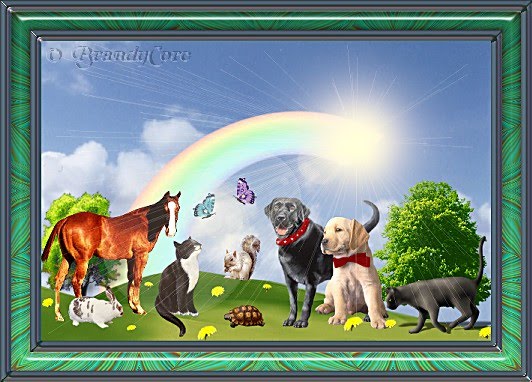
The Rainbow Bridge

In Which an Afterlife for Pets is Discovered, and Subsequent Questions Are Raised

So it happened one afternoon that I was relaxing with a companion and enjoying the fruits of a full cable package when we came upon an astonishing documentary about the lives of Ferret Enthusiasts. The documentary in question mainly focused upon the intricate costumes these enthusiasts design for their weaselly urine be-stenched life partners and the trials and tribulations undergone by those daring enough to enter into the nation's largest competitive Ferret Show, but in and amongst this information was lodged a fascinating tidbit regarding a belief in a sub-realm of Heaven where one's dead pets go to wait for their owners souls to ascend. This is the eponymous Rainbow Bridge.


As a critical thinker, this concept raises many questions. Such as, is there any criteria for the allowance of these animals under the rainbow bridge? Do bad dogs, evil ferrets, malicious macaws, and horses that kicked their owners to death all reside along side the Just and Virtuous Pets? (aside: how did those butterflies get in? Don't tell me those were someone's pets, or that they had any moral concept whatsoever) Are goats or black cats allowed at all, being as they are the emissaries of Satan? Or is there a counterpart to the Rainbow Bridge located at the entrance to Hell? And what of those who's pets follow the doctorines of God above but themselves live lives of base sinfulness? Do they descend into Hell pulling their holy pets down from the rainbow bridge with them to the torments of Hell? Like many of the appendices of the afterlife, this Rainbow Bridge looks to be at the very least, an administrative nightmare for some poor low level bureaucratic Elohim.

The curious may click here for more information (and a midi composition of that song from Ghost and every wedding reception ever)

Monday, February 21, 2011

I have never wondered.

Whilst on one of my recent wintry travels into that sub dominion of Jotunheimr known as Wisconsin, I came across a most helpful tome entitled Why Do We Say It? It has since (dubiously and at times ethnically insensitively) answered many questions (all the while offering no references (outside of the estimation of the author's character that the reader may judge for ones self) whatsover) that I did not have about the origins of phrases that I have often never before come across in my life. Examples abound:

"Paddywhack: Why do we call a light spank a 'paddywhack'?
The Irish call St. Patrick, their patron saint, Paidrag-and so an Irishman is called a 'Paddy.' Irish comedians in the English theater were very partial to the 'slapstick'-and so a 'paddywhack' is a harmless slap on the buttocks in jest."

"Lump it: How did the word 'lump' get into the expression 'if you don't like it you can lump it'?
A person's face will often look 'lumpy' after crying. So to 'lump it' is to sulk or look sulky-and the phrase 'like it or lump it' means 'like it or sulk.'"

"Dead as a Shotten Herring. What is the origin of the expression 'dead as a shotten herring'?
Probably no other fish will die as quickly as a herring when taken out of water. A 'shotten herring' is one that has just ejected its spawn-and should die even more rapidly after being taken from the water."

"Spick. Where did we get 'spick' as a nickname for a foreigner?
Its Navy slang, and a variant of 'spiggoty.' This name for a foreigner-particularly a native of a Latin-American country-was given to the natives of Central America and South America because of their frequent use of the phrase, 'No spick-a dee Ingles.'"


But you mustn't take my word for it. A cursory examination of the tome in question will enlighten one to not only the origins, but the very existence of such words and phrases as Lagniappe, Chinaman's Chance, Queer Card, Slide Kelly Slide, and Tommyrot. Additionally, one may take for what it is worth the author's declaration that the word dude simply comes from a contraction of "dud" (as in my oh my observe the dud's on that fine fellow) and "attitude" to result in a concise term to describe a gentleman going quite beyond the pale in his attempts to dandify himself in the eyes of society.