Showing posts with label culture. Show all posts

Tuesday, April 26, 2011

An Anecdote, a Joke, Two Quotes, and a Pan-o-Rama

In Which a Potpourri is Presented

Acclaimed director Werner Herzog once desired to film a scene in which the smallest man in the world rode the smallest pony in the world whilst being chased around the trunk of the largest tree in the world by the largest rooster in the world. He was stymied by the owner of the largest rooster in the world, who claimed the scene would make the giant rooster "look stupid."

"I never drink water because of the disgusting things that fish do in it."

Several engineers were testing the design of a new style of hot air balloon that they had been working on, but certain flawed aspects of their steering apparatus only became apparant once they had risen quite high in the air. As a result, the engineers found themselves floating aimlessly, lost in the skies. Eventually the wind slowly blew the balloon close to a tall hill, at the surmount of which lay what appeared to be a small university. As the passed by one of the tallest buildings, the engineers happened to notice a figure on the roof. "Hello down there, can you tell us where we are?" one of the engineers shouted. The figure merely looked up in silence at the slow moving balloon. Roughly a half hour had passed, and the building was nearly out of sight when the engineers heard a faint voice coming from the hill top: "You are in a balloon!" "That must have been a mathematicican," sighed one of the engineers. "What makes you say that?" asked another. "He clearly took a long time working on his answer, it was rigorously and provably true, and completely useless in any real world application."

"Five bats depicted quincunially symbolize the Five Happiness (wu fu) - wealth, long life, peace, cultivation of virtue (or good health) and a good death."

Monday, April 25, 2011

A Quaintly Titled Demon, and Other Lexicographical Curiosities

In Which we Once Again Set Sail Upon the Seas of Strange Sayings and Quizzical Terms, for Purposes of Perhaps Enriching the Common Vocabulary of Today Amongst all Who Lay Eyes Upon the Screed

Today we shall go off upon yet another excursion into one of my favorite subjects, that of the long-winded explanation of supposedly commonplace words and phrases of which neither I nor anyone I have ever met have even the slightest hint of familiarity with. I must apologize for the brevity of my introduction today, but I fear that there is more than a modest whiff of ennui emanating from my soul today, and I would fain avoid infecting you, my dear readers, with said taint, as would surely occur, were I to prolong this introduction beyond the scope of performing its mere duty as providing the sparsest of context for what shall follow. Thus with no further ado, let us rejoice in this mild exaltation in obscurity!

Pudding and Tame, familiar to most of us because of a children's chant beginning with those words, has religious associations. It is, according to the Opies' The Lore and Language of School Children, "the name of the fiend or devil 'Pudding of Tame' listed in Harnet's Popish Impostures," published way back in Shakespeare's time. The devilish implications of the name have long since been forgotten by the children who cheerfully chant: "What's my name, Puddin' and Tame. Ask me again and I'll tell you the same." Curiously enough, although the original name is English, the children's rhyme is said to have originated in Maryland. Wentworth's American Dialect Dictionary reports it as turning up all over the country-Arkansas, Mississippi, New York State, and Heaven (or the devil) only knows where else.

Spizzerinctum. This oddity from rural dialect [was previously discussed] and we mentioned that dictionaries define it as cold cash or hard money. The question that led to our discussing this word involved a minister who exhorted his followers to deliver more spizzerinctum. We implied that he was looking for a better-filled collection plate, but a West Virginian reader thought otherwise. "In this area," she writes, "the old people use the word to mean energy and enthusiasm. They say things like 'I wish I had his spizzerinctum,' when speaking about a young person. Undoubtedly this is how the minister meant the word. If you had attended an old time revival meeting in my neck of the woods, you would know that joy, energy, and enthusiasm= are much more in abundance (and much more desired) than cold cash!'"

Welsh Rabbit/Rarebit (which the more observant amongst us will recognize from a previous column). A widely held misconception is that Welsh Rabbit is a vulgar form of Welsh rarebit. Actually the opposite is true, for Welsh rarebit is merely a mannered and affected corruption of a phrase that dates back nearly to Shakespeare's time. In those days only the wealthy in Wales could afford game from royal preserves. So since rabbit itself was such a rarity, melted cheese on toast became known semi-humorously as Welsh rabbit. In a similar fashion, scrambled eggs on toast spread with anchovy butter came to be called Scotch Woodcock. Up in New England today, you may occasionally hear codfish called Cape Cod turkey. It's unfortunate that the editors of some cookbooks have helped to spread the nice-nellyism rarebit. Perhaps it's because the term has long been a favorite of restaurant menu writers-a curious breed who seem never to be able to say anything simply. H. W. Fowler, as usual, has a brusque and trenchant commentary on the manner. "Welsh rabbit," he writes, "is amusing and right, and Welsh rarebit stupid and wrong."

One more stitch in the wildcat's tail. This odd expression comes to our attention in a note from a reader who said that his grandmother, after finishing a difficult job, would say: "Well that's one more stitch in the wildcat's tail." We asked our column readers if any could tell us more about the expression, and Frank Flanagan obliged. He wrote: "My late father, God rest his merry soul, would now and then come home smelling of strong drink and with a yen to sing. He had a very good voice, and he could really belt out his favorite songs. One of them went like this, to my Jewish mother's disgust:
'Way down south in St. Augustine,
a wildcat jumped on a sewing machine.
The sewing machine was going so fast
It took 44 stitches in the wildcat's...'
Maybe the lady made a slight change in her version."

Thursday, April 14, 2011

In the Interest of Generating Even More "Paddywhacks1"

In Which We Explore the Carnal Delights to be Beheld in the Works of One Who Was Once Heard Declaiming 'Literature and butterflies are the two sweetest passions known to man;' A Quote Striking in its Thematic Applicability to My Introduction to the Essay Below.


In Japan, one singular butterfly symbolizes femininity, while a pair of butterflies symbolizes marital bliss. In Greek, the word for butterfly is also the word for soul, as well as the name of a character in a well known myth2. These allusions lend a certain credibility to the otherwise sordid nature of a certain paperback edition cover illustration belonging to Nabakov's Ada, as exhibited above in all of its ragged glory. Nabakov has been celebrated as one of the 20th century's finest prose stylists, although many have called him to task as relying on formal conceits and witty prose as masks for novels devoid of little inherent worth3 (although the fact remains that it is hard to decry the charms of anyone capable of lines such as "Let the credulous and the vulgar continue to believe that all mental woes can be cured by a daily application of old Greek myths to their private parts” and "There is nothing in the world that I loathe more than group activity, that communal bath where the hairy and slippery mix in a multiplication of mediocrity"). Today's installment of literary lust has the misfortune to be merely an excerpt from his masterwork "Ada." There is little to be found in this novel in the way of prolonged passages depicting rigid anatomical descriptions of amorous acts, yet the entirety of the text nearly throbs with anticipatory excitement; the deeply suggestive and sensual language allows the reader to complete for his or herself any actions hinted at by the narrative. The prose is practically engorged, in other words. For example:

"'I wannask,' she repeated as he greedily reached his hot pale goal.
'I want to ask you,'she said quite distinctly, but also quite beside herself because his ramping palm had now worked it's way through at the armpit, and his thumb on a nipplet made her palate tingle; ringing for the maid in Georgian novels-inconceivable without the presence of elettricita-
(I protest. You cannot. It is banned even in Lithuanian and Latin. Ada's note.)
'-to ask you...'
'Ask,' cried Van, 'but don't spoil everything' (such as feeding upon you, writhing against you).
'Well, why,' she asked (demanded, challenged, one flame crepitated, one cushion was on the floor), 'why do you get so fat and hard there when you-'
'Get where? When I what?'
In order to explain, tactfully, tactually, she belly-danced against him, still more or less kneeling, her long hair getting in the way, one eye staring into his ear (their reciprocal positions had become rather muddled by then).
'Repeat!' he cried as if he were far way, a reflection in a dark window.
'You will show me at once,' said Ada firmly.
He discarded his makeshift kilt, and her tone of voice changed immediately.
'Oh dear,' she said as one child to another. "It's all skinned and raw. Does it hurt? Does it hurt horribly?'
'Touch it quick,' he implored.
'Van, sweet Van,' she went on in the narrow voice the sweet girl used when speaking to cats, caterpillars, pupating puppies, 'yes, I'm sure, it smarts, would it help if I'd touch, are you sure?'"

and so on, in that style.


1see "I Have Never Wondered" and "In the Interest of Generating "Paddywhacks" for some context, if it should prove necessary.

2Psyche was the youngest of three princesses, and as is often the case in tales such as this, was undescribably desirable. It seemed that all who met this fair maiden grew inflamed with yearning. Such was the degree of distraction as a result of the fervor that this nubile instilled among all that people began to omit worshiping Aphrodite, saying to themselves "We have among us a mortal who truly embodies all that Aphrodite represents, why should we waste our time burning delicious animal fats to some distant goddess lounging about sipping ambrosia on some far off mountaintop?" Aphrodite, being a lust goddess, amongst other things, was naturally a capricious and vicious sort, and sent her son Eros, the god of childish infatuation, down to fuck with Psyche. He was given orders to prick her with one of his arrows in order to cause her to desire some ugly fellow (of course the worst punishment that Aphrodite could conceive would be that of a beautiful woman falling in love with an ugly man. But no one has ever accused the Olympians as being anything but amplified representations of humanities coarsest features, so). Psyche's beauty was such that even Eros could not withstand her guiles, even as she slept, so not only did he not prick her with his arrow, he went and pricked himself (hmmm) as he watched her sleep (creepy yes, see above aside on the nature of Greek divinity) and distracted by his desire for the fair maiden, forgot all about his duties of shooting his love-arrows willy-nilly about the world. This all goes on for quite a while, with all sorts of more fairy-tale elements seeping into the story, what with the bit where Psyche finds herself married to some strange fellow who keeps her well tended in a secluded valley but is instructed to never look upon his face else some dire fate will befall them, or the part where Aphrodite forces Psyche to undertake a series of three (of course) labors of a pathologically obsessive-compulsive variety and is assisted by various ants, river-daughters, etc in their completion. The bit where her sisters throw themselves off a mountain with vain hopes in heart is the stuff of pure Greek myth though. But the relevant point being, psyche, the butterfly, was symbolically close to infatuation and lust in Greek mythology.

3his rejoinder to such: "Style and Structure are the essence of a book; great ideas are hogwash."

Wednesday, April 6, 2011

In Defense of Quim

In Which a Catalogue of Antiquated Coarse Euphemisms is Displayed, For the Purposes of Enlivening The Arousal of All.

Whilst researching upon the mild terms of abuse noted in an earlier Posting, I could not help myself but search for some harsher terms in the interests of discovering what possible origins and historical synonyms existed. Thus I arrived at the conclusion that for this weeks Smut for the Refined should take on a more etymological and less literary bent than in the past, as persuing a wide range of interests is always sure to

Of Ass-Hole little is said other than the term is an Americanization of the Common Coarse Germanic term Arse, which has been found on its own as far back as one thousand years in written English, and poetically compounded with -hole for at least six hundred years. Examples in text "Emoroydes beþ five veynes þat strecch out attiþ þe ers," (for assistance in reading see "An Index of Extinct Letters")and "They lete hange fox tailles‥to hele and hyde her arses." A host of evocative synonyms over time include cule, tut, bewscher, croupon, dock, hurdies, prat(memorialized in the term "prat-fall"), posteriums, podex, fundament, flitch, quarter, hinderland, stern-works, jacksy, sit-me-down, quoit, and rusty-dusty. A notable sub-category detailing terms referring specifically to the cleft offers creek, nock, and nockandro for our enlightenment. In other related tangents the word Kallipyg(which naturally comes from the Ancient Greeks, an Ass Appreciating Culture if there ever was one) may be administered to one who's buttocks are of divine proportion.

Prick is yet another gift from the Germanic heritage of our tongue, with close relatives existing in Old Frisian as well as scads of Norse languages. " To turne his pricke vpward, and cast a weauers knot on both his thumbs behind him," and "The pissing Boye lift vp his pricke." The OED lists all of the usual suspects in cock-synonyms as well as a variety of more creative terms like weapon, pintle, pillicock, tarse, loom, verge, pillock, rubigo, prependent, runnion, pego, membrum vitale, pudding, intromittent apparatus, John Thomas, micky, prong, whanger, winkle, meat tool, swipe, and ding-a-ling

Fuck has a long and storied history, although the vast majority of possible etymologies lay primarily within the range of apocrypha (by way of disputing a popularly held mis-conception: If one wishes to take as gospel the information one finds by way of this fellow and his companions, caveat emptor) and out-right balderdash. I hesitate to paraphrase the following information, so without alteration from the OED:

Probably cognate with Dutch fokken to mock (15th cent.), to strike (1591), to fool, gull (1623), to beget children (1637), to have sexual intercourse with (1657), to grow, cultivate (1772), Norwegian regional fukka to copulate, Swedish regional fokka to copulate (compare Swedish regional fock penis), further etymology uncertain: perhaps < an Indo-European root meaning ‘to strike’ also shown by classical Latin pugnus fist (see pugnacious adj.). Perhaps compare Old Icelandic fjúka to be driven on, tossed by the wind, feykja to blow, drive away, Middle High German fochen to hiss, to blow. Perhaps compare also Middle High German ficken to rub, early modern German ficken to rub, itch, scratch, German ficken to have sexual intercourse with (1558), German regional ficken to rub, to make short fast movements, to hit with rods, although the exact nature of any relationship is unclear.


As someone who has never had the opportunity to fuck a German, I cannot personally attest to how much their intercourse resembles rubbing, making short movements, or being struck with rods, but one can only imagine.

The word has for some time only referred to Carnal Intercourse, which of course is what occurs when one does not copulate with one's Wife and the sole blessed intent of procreating and thereby increasing the number of God's Children upon the this Mortal Sphere, but engages in sinful and depraved fornication for purposes of Gratification of a Physical Nature. As, of course, depraved fornication is almost by definition more interesting than blessed procreation, there are innumerable historical synonyms for carnal intercourse, for example felter, swive, jape, mell, jostle, tup, jumble, grind, commix, wap, bolster, occupy, subagitate, fanfreluche, jig-a-jig, perform, pull a train, and molluck.

As a side note of some small interest, there is a bird named Windfucker. I am telling you the truth, my friend; if you believe me not see Lenten Stuffe by T. Nashe for verification. And then forever ban thyself from reading this web-blog, for I shall have not Doubting Thomases numbering themselves among my Devotees and Acolytes.

Finally, let us finish with a Bang! so to speak, and with no further ado, Take a Look at the History of that most infamous of todays Heavy Cusses: Cunt. It is clearly (note the overall harshness of its pronunciation) of Germanic origin(as are all of the words examined here today. One might be able to argue that the seeming prominence of Germanic origins of coarse language in the English tongue may have to do with the Anglo-Saxons were for some time the under-classes in Southern Britain with the language of the Noble Classes being a form of French adopted by Norse conquerors of first Nuestria, then England(Norman being of course a form of "North Man"), thus leading to Saxon words having a distinctly earthy connotation as compared with the more refined air of the Romance Language additions), with similar phonotypes existing in Norwegian (kunta), Danish (kunte), and the Germanic kunton. The oldest known usage of the term in the English tongue is found in a compendium of informal street names in 13th century London, where one can only imagine what activities would take place upon the illustratively titled Gropecuntelane. Further along in history, in a Folio of "Loose and Humorous Songs," one comes across the lyric "Vp start the Crabfish, & catcht her by the Cunt," unfortunately with little context (or sheet music) for accompaniment. Alternate vernacular terms for the region of interest throughout time include Privy-Chose, the Shell, Lap, Quim (indubitably my favorite, and one I have vain hopes of reintroducing into common parlance), Honey-Pot, Parovarium (or the Organ of Rosenmu(umlat)ller), paroophoron, Minge (my second favorite), Pocket-Book, and Zatch.

Who would I be if I ended this transcription without suggesting some form of diversion by which one can utilize some, if not all, of the delightful information found herein? Attempt to initiate some depraved fornication of your own, using any whatever methods you prefer (myself I utilize a half unbuttoned cardigan accompanied by a partially finished New York Times Sunday Crossword Puzzle, and let my sheer animal charisma do the rest), and then whilst in the midst of fornicating, interject various "pillow phrases" such as "Allow my Rubigo lay entry to your Quim," or "Tumble me in the quoit with your rude pillicock." It will be sure to enliven your life, one way or another.

Tuesday, April 5, 2011

How to Best Construct a Rye Whiskey Manhattan

"In Which a Conundrum of Cast Upon Spirits is Outlined and a Resolving Pick-Me-Up is Detailed"

There are times in one's life when Grey Skies frown down upon one's self, when the Rays of Apollo touching one's soul are diminished, when Smiles of Elation turn to Saturnine Sighs, and in these times of less than optimal spirits, Man has ever turned to his Oldest Recipe for means of Cheer. I speak, of course, of the Spirit Alcohol, which in it's basest form is likely to have predated any other of Mankind's Inventions. It could be said that there are Countless Varieties of Cocktails by which Man can imbibe his Joi de Vivre (although from the point of view of a Rigorous Mathematician1(and why on earth would one choose any other point of view, given a choice?) one would have to concede that this set, even given the unlikely possibility of having cardinal magnitude, must by necessity be countable), but as a Man of some Refinement and Culture, I implore you to ignore the vast lot of Possible and Improbable concoctions available as they are but Vile blends of Fruit Liquouers and Simple Syrups, mixed with the intention of Tricking the Morally Naive into consuming more than their fragile resolves can sustain. Nay, I say that it shows Magnitude of Character to Consume a drink wherein one can Taste upon his very tongue the flavor (and also requires one to put forth the required effort into actually using a Quality Liquor for one's drink, as opposed to the swaths of artificially colored and flavored distilled corn mash masquerading upon the lower levels of Liquor Stores everywhere) and quantity of Alcohol in one's cocktail. Thus I present to you, with no small amount of fan-fare, a Recipe for the most Ideal of Cocktails: The Manhattan.

The Recipe: it is a simple affair, so long as one has the means by which to calculate the most obvious of ratios and does not over-dose the bitters: One simply pours two parts straight rye whiskey(see earlier note regarding the strict avoidance of corn mash), one part sweet vermouth, and a Dash (this means one medium sharp stroke of the Angostura over the glass. Do not Over-Dose, lest the flavor becomes too Bitter-ey to bear) of bitters into a tumbler. Ice can be added or subtracted to your desire. No more than two cherries should be added, and by cherry I do not mean some congealed sphere of pinkened Xanthan Gum that has been Drowning in Syrup for the duration of its entire artifical lifespan, but an actual cherry, one who has been touched by sunlight and rain drops at some point in time, and then when ripeness was reached, was lovingly plucked and delivered to your drink within a span of 4 days maximum. For alternate flavors, one may substitute the zests of any of the acceptable range of citrus (I suppose I must offer some delimitations for those without the Taste and Refinement I have acquired through some effort through out the years: Lemon and Blood Orange are appropriate, Honey Tangelo and Ruby Red Grapefruit are not). Then swirl the glass counter clockwise several times, retire to a comfortable chair, and enjoy.


1
Combinatorists do it discretely.
(Logicians do it) or [not (logicians do it)].
Logicians do it by symbolic manipulation.
Algebraists do it in groups.
Analysts do it continuously.
Real analysts do it almost everywhere.
Pure mathematicians do it rigorously.
Topologists do it openly.
Dynamicists do it chaotically.
Mathematicians do it forever if they can do one and can do one more.

Thursday, March 31, 2011

A Footnote in the History of Swindlery

In Which Crimes Against Both Humanity and Livestock are Regaled for One's Lazy Thursday Perusal

In days of yore upon the Isle of Albion, the scourge of Bird-Swindlers wreaked havoc on hopeful gift-givers, whether they be for one's nephew's saints day celebration, a way of apology to one's spouse, or for sly seduction of a fair serving wench. The occupation of Bird-Swindler involved ensnaring some local common English avian, something along the lines of a Finch or Sparrow, and then with the aids of scissors, dyes, and modified prosthetic feathers, modifying the appearance of the bird in such a way as to trick potential customers into believing that they have in front of them some rare breed of The Bird of Paradise itself. Bird-swindlery was far from the only animal related crime in England at the time, a perusal of court dockets from the past reveals numerous and original malfeasances such as fox riggery, selling a man oats intended for cattle, calculating the horoscope of an ass, wasp divination, impersonating the cry of a cuckoo, poaching the queen's cod, and introducing an eel into the anus of a horse.

Wednesday, March 30, 2011

"The Dwellers in the Mirage"

In Which but a Fraction of My Astonishing History is Recalled, For Purposes of Drawing Attention to an Art Form That I Have Ever Held in High Esteem

Long ago, when I was still but a whelp of a child, I plied the trade of a ship's boy, an occupation into which I fell after the tragic circumstances1 befell the dakotan compound wherein I was born left me to fend for myself at a tender age, a misfortune that I first dealt with by working my way o'er the Boundary Waters by way of trapping and selling the hides of the great beavers which still swim through those insect infested bogs until I reached the port city of Duluth wherein a gang of be-shore-leavened sailors, little older in years than myself, but afforded ages of experience of which I had no conception of as of yet encouraged me to wager my beaver-earnings upon a series of dice games of varying honesty, whereby I ended up indentured to the lot of them and thus indirectly press-ganged onto the notorious Ophiucus3 which I was later to discover plied most of it's trade during the New Moon, if you catch the wink I am sending your way, and was later to meet a most untimely end off the Barbary Coast which was to lead to all manner of unexpected outcomes for your narrator which i must refrain from digressing into at this exact moment as this introductory passage grows to ever increasing lengths, much like unto appeared to me the great tendrils of the Kraken that beset my fondly remembered Ophiucus once upon one eternal day in the arctic sea as we had ventured into the northern waters following the direction of some strange lode stone of a curious pseudo-compass that the first mate Randolph had stolen from the carefully locked ivory4 chest of the Filipino Lass he spent one Tuvaluan week-end fucking which was later to lead us in ever decreasing concentric circles about an immense iceberg, frozen inside of which was what appeared to us a gigantic series of nested catacombs containing any number of peregrinate relics which we initially viewed a fantastic treasures but later were to understand were possible the worst degree of curse.

There were numerous entertainments to be held by a naive soul as I fancy I was at the time, mostly belonging to the aerthly realm populated by cussing, beer drinking, advanced spitting, and introductory whore-mongering. But out of all the past-times indtroduced to myself during that time, the one that remains a fond divergence even to this day is the evening enjoyment of pulp magazines. The lurid titles and eye catching (and gregariously assumed) names of the authors fed the fires of my previously rustick imagination. But this is not even to mention the prime appeal of these spirited broadsides: the salacious cover illustrations, practically begging any youth to educate himself on what thrilling and indecorous acts were to be beheld within. Now, with no further mono-logue, allow me to present to you a slim gallery of but a selection of my favorite pulp illustrations. Onwards!


1which I will speak little of at this point other than that they involved a little know even to this day clan-destine sub-division of the US Federal Government's law enforcement agencies which was rumoured to have had it's beginnings under the auspices of Cotton Mather2 and a haunting stretch of the compuound wherein only the sickliest rye grew, and that in tantalizingly and nearly geo-metric patterns...

2which may confuse those who are under the widely held impression that United States of America did not even exist as a political entity at that time, to which I say, there are many histories available to us, the ones we choose to believe as truth are typically more an issue of aesthetics than veracity.

3

4"Yet to the touch it somehow felt denser, not in terms of weight, but in, how can I say, palpability? Somewhat like the feeling one gets in a dream when some sound or touch from the waking world interjects and for some half remembered moment dream and reality co-exist as one..."

Tuesday, March 29, 2011

A Garden Path Through a Confused Grammarian's Lexicon

Whilst today one can select from the theories of Stochastic Processes, Con-Spiracies of varying degrees of malevolence, Chaotic Dynamics, or simply pure Nihilism in order to explain away the seemingly un-caring randomness of the universe, in ancient days Men had contrived Deities whose purposes seemed to be divine emodiments of capricious urges and malicious pranks1. The Norse painted their trickster god as alternately a figure of malicious rage, a cunning techno-logy innovator, or a mischievous relief side kick3; While the Coyote figure in many native american stories apprehends a more hapless stance, acting typically out of selfish urges and often suffering many comical slapstick mis-fortunes as a result of his deceits5.

The point being, that in order to console ourselves with various aspects of un-predictability, it is often helpful to Name this phenomona, a process by which we come to Know it, and accustom ourselves to it's existence. This Action of Naming suffuses our lives to such a degree that we often over-look it's omni-presence, and I consider it a part of my Duties as a Web-Logger to assist in drawing attention to this uniquely human phenomenon. Leading us by quite the elliptical garden path to today's subject at hand: unpredictability and chaos in sentence structure.

A Garden Path sentence is a grammatically correct sentence subject to multiple divergent parsings depending on how the reader chooses to interpret the various clauses. Typically this is a result of words that seem to function simultaneously as multiple forms of speech within various interpretive contexts of the sentence. Examples include:

The old man whistling tunes pianos.

The tomcat curled up on the cushion seemed friendly.

The cotton clothing is made of grows in Mississippi.

The man who hunts ducks out on weekends.

The Eskimos can fish in a new factory three miles away from sea.

He gave the child the dog bit a band-aid.

We painted the wall with cracks.

Fat people eat accumulates.

The prime number few.

A Paraprosdokian is a figure of speech that begins normally enough but at some point veers off course into a differing context, causing the reader to re-interpret the meaning of the first clause. Famous examples include:

"If I am reading this graph correctly, I'd be very surprised."

"I haven't slept for ten days, because that would be too long."

"She looks as though she had been poured into her clothes, and forgot to say when."

"My father said, 'I'll miss you son,' because I had broken the sights off of his rifle."

"Have you ever tried just sitting down with your children, turning the tv off, and hitting them?"

"Laudandus, ornandus, tollendus6."

"I like going to the park and watching the children run around because they don't know I'm using blanks."

Antanaclasis (or often, antistasis) are sentences wherein a key word or phrase is repeated in a way that takes advantage of a word's multiple meanings to change the expected interpretation of the sentence. Naturally, I have clarifying specimens:

"Time flies like an arrow, fruit flies like a banana."

"Your argument is sound, nothing but sound."

"We must indeed hang together, or most assuredly we shall all hang separately."

"Those who are not fired with enthusiasm will be fired, with enthusiasm."

Syllepsis, or semantic zeugma, is a deliberate inflection of grammatical rules generally used by lyricicists and poets (not to mention classical hard boiled noir authors and Groucho Marx) for it's disorienting yet pleasing effect. The zeugma in general is a series of phrases joined by a single common word; this semantic zeugma occurs when the fulcrum word has multiple interpretations which are exploited by the multiple phrases. And who would I be if I did not have revealing exemplifications?

"Oh, flowers are as common here, Miss Fairfax, as people are in London."

"[The rat] returned in haste and flames to its original hideout."

"When he asked "What in Heaven," she made no reply, up her mind, and a dash for the door."

"You are free to execute your laws, and your citizens, how you see fit."

"You can leave in a taxi. If you can't get a taxi, you can leave in a huff. If that's too soon, you can leave in a minute and a huff."

"Monica had exploded, and I had a mystery, and pieces of her pancreas, on my hands."

I hope this linguistic gallery has been both amusing and instructional. Perhaps for purposes of merriment you can infuse one of your daily memorandums with a handful of self-constructed exemplars of the above listed sentence forms and watch the con-fusion and chaos in your life increase, secure in the knowledge that this ataxia can be laid squarely at your own doorstep.

1Einstein famously said "God does not play dice with the universe," and while it is quite clear to anyone familiar with the history and past-times of the but lately (in historical terms) promoted War-God of the Israelites that He certainly wasn't a Gamer (not in the strict "Games of Chance" context perhaps, but his antagonism with The Antagonist can certainly be interpreted as a Zero-Sum Game2 per se, it is not suitable to conclude that No God plays dice with the universe. Einstein may be forgiven for his assumption though, not being trained the methods of mystical meta-mathematics.

2see Von Neumann's Theory of Games and Economic Behavior.

3see various myths concerning the mis-adventures of Thor and Loki that appear to be the originals of the mis-matched buddy comedy genre so beloved by Shane Black and his descendants ("Someone has stolen the Thunder God's might hammer Mjolner, and to get it back he is going to have to join forces with the notorious half-Jotun4 loose cannon Loki and together go undercover as goddesses betrothed to Frost Giants" for further details see Þrymskviða...)

4essentially an ethnic minority, at least in Asgard at the time.

5not entirely unlike Chuck Jones' noted Wile E Coyote.

6"He must be praised, decorated, and tolerated."

Monday, March 28, 2011

"The Proper Mustard"

In Which a Brief Digression Into the History of Mustard is Made, by way of Providing a Context for an Edifying Excerpt Regarding the Origins of a Famous Phrase

The ever delightfully searing condiment known to us as mustard originated, as so many of our prized refinements, from the days of the Roman Empire. An ancient recipe book details the mixing of grape juice, known in the local tongue as Must, with ground sinapis seeds, to create a heady paste with the descriptive title Burning Must, or Mustem Ardis as the Romans would have it. The longstanding popularity of this condiment into our present day is likely due to the sheer adaptability of the bases of ground mustard seed and vinegar to most any additive one could dream up1

This is all fine and dandy, one might be apt say, yet one question yet remains: By God's Wounds, how did the expression Cut the Mustard originate? Well, my dear friends, you may cease your fretting and prepare for a silent and dignified jubilation, as I have, with the aid of Morris' fine Dictionary of Word and Phrase Origins, pin-pointed the antecedents of this expressive idiom.

cut the mustard was originally a Western expression, popular among cowboys during the late nineteenth century. If something was "the proper mustard," it was O.K., the genuine article. Andy Adams used the expression this way in his famous Log of a Cowboy , when he wrote that 'for fear the two dogs were not the proper mustard, he had that dog man sue him in court to make him prove the pedigree.' And Carl Sandburg once wrote: 'Kid each other, you cheapskates. Tell each other you're all to the mustard.' The expression cut the mustard then came into vogue, meaning to come up to expectations, to be of good quality. In one of his short stories, written around the turn of the century, O. Henry described a pretty girl in these words: 'She cut the mustard all right.' Nowadays the expression is usually used in the sense of being successful. Of a leading businessman, you might hear it said that 'he really cuts the mustard

And that, my dear readers, is the Proper Mustard indeed.

1among many of the options one can take their mustard prepared with: cider vinegar, prickly pears, the infamous Blut Jolokia Ghost Peppers, persimmons, wasabi (or horse radish to the occidentals), figs, honey pecans, cream, tarragon, beer (a tradition orginated in the Mid-West, naturally, garlick, ginger, Maui Onions, verjuice (the "secret ingredient" in Dijon Mustards), fennel, cinnamon, turmeric, and sandillions more.

Wednesday, March 23, 2011

Cardano's Betrayal

In Which a Romantic Account of a Famous Mathematical Dispute is Recounted, Motives Are Recklessly Assigned, and Dark Questions Are Raised


I find it hard to imagine that this hoary tale is not in common parlance, but such is but one of the many delusions of the amateur mathematician in these dreary days1. It is a tale of booze soaked treachery and high stakes competetion from the days when mathematics was a royal sport and the exact solving of cubics was a high stakes game that only the most strong of mind and character dared attempt.

No tale can be said to have one true beginning, if I may be forgiven for utilizing this cliche2, but I shall choose as a suitable start to introduce the character who serves as the protagonist of this affair. Niccolo Fontana Tartaglia was born in Brescia, where he obtained his last name3 as a result of a French soldier stabbing him in the mouth, inflicting a life long speech impediment upon our protagonist. As a man, Tartaglia had obtained for himself a local reputation of being both well-endowed with skills of a mathematical nature and a boastful tongue, and as was the manner of the time, found himself challenged by one Antonio Fiore to a contest of mathematical duel, in which each contestant was to produce a list of 30 problems that their opponent must solve within several days. Tartaglia put together a wide variety of intricacies, but Fiore submitted only cubics, expecting to humble his oppugnant4. After many painstaking days and nights of formulaic manipulation, Tartaglia formulated an algorithm for solving all cubics, with which he then swept through the problems like an oiled scythe through autumn dried wheat, defeating a chastened Fiore. Keeping in with the style of the times, he kept his general solution a secret and used it only for challenging other mathematicians with solving seemingly impossible cubics.

Enter Gerolamo Cardano, a character who's life accomplishments included chopping off his son's ears, undergoing a prolonged prosecution for heresy for his calculating and publishing the horoscope of Jesus, compiling the first treatise on Probability theory that helpfully included detailed methods of cheating at games of chance, and his claims that deaf people were not idiots and could in fact use their minds much like that of those endowed with aural faculties. In short, a complicated man, and not to mention a literal bastard, who's potential in the ways of abstract reasoning was only exceeded by his capacity for devious and capricious actions. Cardano had heard of Tartaglia's victories over many, and grew convinced that his fellow Italian had obtained a general method of solving the cubic. For whatever initial reason5, Cardano felt driven to apprehend this solution for himself, and thus he extended an invitation to Tartaglia under the pretenses of introducing him to the Marchese of Milan at a soiree at Cardano's abode. Accounts differ as to whether said meeting actually occurred, but by Tartaglia's account, after being plied with liquors and panegyrics by the cunning Cardano, Tartaglia finally relented and shared his algorithm with Cardano, but only after forcing him to swear the following oath:

I swear to you by the sacred Gospel, and on my faith as a gentleman, not only never to publish your discoveries, if you tell them to me, but I also promise and pledge my faith as a true Christian to put them down in cipher so that after my death no one shall be able to understand them.

The following day Tartaglia left Milan in some hurry, perhaps sensing what history has show us to be true: that Cardano held neither faith as a Christian nor a Gentleman.

Time passed, as it is ever wont to do, and Cardano stayed true to his oath, holding Tartaglia's Method close to his bosom in a manner unto like that of a sympathetic woman and a small injured animal. And it is possible that in a another world, Cardano could have kept his oath, except for being that in this one he took in the prodigy Ferrari as apprentice. Together they worked on any number of the celebrated abstruse intricacies of the time, towards the interest of publishing a compendium of the pair's various techniques and transformations. But then it came to pass that Ferrari, through painstaking labors, secured a method by which one could solve a certain variety of quartic equation. Including this method in their proposed mathematical epic would secure their place as the finest mathematicians of the time, yet there was one miniscule fly trapped in the proverbial ointment: Ferrari's method reduced a problem of quartics to that of cubics.

Cardano, ever wily, realized that there might yet be a path by which he could side-step his oath. Coupling his knowledge of the duel between Fior and Tartagliga with his personal estimation of Fior as an uninspired man, Cardano theorized that not only did Fior have his own cubic method, but that it was almost certainly not of Fior's derivation, but that of his tutor, Del Ferro. Armed with suspicions, Cardano and Ferrari set off to Del Ferro's estate, where by some obfuscation they managed to gain access to the now deceased mathematician's papers. In which, they found Del Ferro's cubic method clearly outlined, and with that, a loophole by which oaths sworn could be forsaken. Sparing no time, the pair published their works in quartics, cubics, and much more in the Ars Magna6 to the great outrage of Tartaglia, who then publicly denounced the pair, revealing the Oath that Cardano transgressed, and then challenged Ferrari to a mathematical duel. Perhaps justice would have dictated that The Stammerer upset The Upstart, but no man observant of the ways of our world would imply that any form of justice is inherent in such workings. Tartaglia lost, and in the face of such disgrace and ignominy, retreated from the public eye, never to be heard from again.

A fact of note in this story is that several mathematicians seem to have independently derived solutions to the cubic but kept them as deeply held secrets. Earlier, I noted that the justification for this was simply a matter of the times, but it is likely that something more kept these mathematicians in a state of allowing the results to be known but the methods to be secret. It is that all general methods of solving the cubic make allowance for the appearance of the square root of negative 1 or i as it is now known, and at the time, most gentlemen of well breeding would have declared you to be a madman for even contemplating such profanity7. Indeed, a look at works of the time divulges a distressingly puritan squeamishness to even contemplating negative coefficients in polynomials. Thus we have that it took an audacious blasphemer such as Cardano to publish any such method, his justification being that it acheived results.

Nevertheless, what are we to make of the fact that if we approach history from the view point of a vectorist, we have that multiple mathematicians almost simultaneously and independently did work that would lead to the public acknowledgement of the existence of i, being at the very least, a necessary evil among the mathematician's lexicon. What if i wanted to be discovered? What if Someone (or Some Thing) wanted i to be discovered? Dwelling in some dark recess, unknowing of time, a blinking, throbbing, nameless urge flickered when brushed by human consciousness, like the hint of stirring movement spotted peripherally in the mirror of an unlit bathroom, and knew hunger. But for who's gain? Was Cardano the self-promoting inscrupulous bastard historians have painted him as, or another in a long list of patsies in some Archon's scheme, flicked about by unseen fingers (talons? unspeakable appendages?), smirking at his people's God while Some Thing, Some Where, twisted his desires, for devious purposes unknown to men?...perhaps they have already come to pass...perhaps they yet lay on the horizon...


1Indeed, I often have to be reminded that the concept of a mathematician held by most is that of a mere calculator, idly adding and subtracting large numbers for the supposed sheer thrill of it all, as opposed to the actual goal of discovering the only truths we can prove in this universe.

2but what better way to begin a story I have already described once as hoary?

3meaning "Stammerer."

4Fiore had learned method from Scipione Del Ferro which painstakingly avoided dealing with any negative coefficients and thus avoided explicitly dealing with any negative roots(but still they lurked, between lines of calculations, like some impossible beast waiting to strike). Ferro kept his method a secret to all but two, as it was common for natural philosophers of that day to hoard their discoveries as to benefit all the more from the rarity of their knowledge. See any of numerous works on the Calculus Wars between the continental acolytes of Liebniz and Newton's co-horts in the Royal Society for more on the evolution of that world into ours.

5glory, exploration, exploitation? or was this part of some more grand devious scheme in which the individual motivations of mere men were but pieces on some multidimensional game board?

6to Cardano's merit, he at no point claims either cubic method for himself, but gives credit where credit was due

7currently and historically, mass culture's view of i is sometimes strange to the rationalist, as why one would somehow single out this entity as being somehow more fantastic and strange than other such entities that we do not come across in the percievable physical world like pi(a transcendent), root of 2(an irrational), or a circle (show me an actual circle8) in real life and I will show you an ellipse). likely much of this stems from the adoption of the term "imaginary" stemming from Descartes' dismissal, which might be better than Cardano's description of them as "fictitious" although quite frankly Euler's description of them as impossible numbers does not help either, nor does the forbidding term Complex numbers favored these days. When one actually considers the mathematical foundations of our current number systems (non-negative integers from the empty set9, the integers from closure under additive inverses, the rationals from closure under multiplicative inverses, the reals from closure under the convergence of all cauchy sequences, and the complex numbers from algebraic closure of the reals, the concept of somehow considering one of these sets as more "real" or "imaginary" becomes ridiculous.

8besides x^2 + y^2 = 1, smart ass

9{}, {{}}, {{{}}},...

Tuesday, March 22, 2011

Paradox and Snowflake

In Which a Breviloquent Digression Into the Exact Consistency of the Word Paradox is Ventured, Followed by an Rigorous Mathematical Example of How the Word in Question Has Been Mis-Used

From various etymological sources in my upper level athenæum where various word and name references are stored, along with a good sized collection of entaxidermied civets, genets, binturungs, and so on, a miniature model of the Ptolemaic Universe which plays a haunting melody when one turns the crank with which the various planetary epicycles are empowered, as well as a quite stunningly and accidentally achieved collection of spiders and bats who maintain an uneasy hegemony regarding the mass consumption of the variegated insects who delight in ancient book fibers and embalmed vivveridæ, I have that the word paradox comes from the Latinate "paradoxum," meaning a statement which is seemingly absurd but actually true, which itself stems from the Greek phonemes "para" meaning contrary to and "doxa" meaning opinion. If we are to take this as our definition of the term, then in modern parlance this word has been molested and mis-used to stunning degree unrealized by few words other than the unfortunate ironic. Far be it from me to berate anyone for the rampant mis-understanding of words, the challenge of correcting word usage en masse is a sport fit only for elderly men with leather elbow patches on their tweed sport coats and the young and arrogant. My opinion has always been that it is best to leave the will-fully ignorant in their blissful states. Ah yes, but back to the supposed paradox at hand, attributed to Zeno in his solipsistic attempts to prove that motion and change were but mere illusions1:"That which is in locomotion must arrive at the half-way stage before it arrives at the goal." The fundamental mis-understanding inherent in this supposed para-doxa is that a finite length can only be sub-divided into finite portions, a statement that anyone with glancing familiarity with the Real number system (quite frankly even the Rationals will do in this case) knows is an assumption fit for laughter and jeers. While I shall not force you to endure a construction of the Real number system from the basic axioms of set theory (today, that is), I shall offer a quite concise animated example of the phenomena at hand, the Koch Snowflake. It is a shape with infinite perimeter yet finite area2


Entrancing, no?

1The Dean of a prominent university invited the head of the physics department in to berate him for his department's constant budget over-runs. He cites as a positive example the mathematics department, who's budget consists only of allowances for paper and wastebaskets, or even better, the philosophy department, who's budget consists only of allowances for paper.

2One constructs the Koch Snowflake by first constructing an equilateral triangle, then affixing equilateral triangles to the midpoints of each side, and then so forth

Monday, March 21, 2011

Unmurmuring When Every Jar Was An Agony

In Which an Abbreviated Biography, In One Parse-able Yet Seemingly Interminable Sentence, Of the Noted British Eccentric Country Squire Lord John "Mad Jack" Mytton is Presented, With the Objective of Acquainting You, My Dear Readers, With the Type of Fantastic Bull-Shit that The English Have Accustomed Them-Selves to Putting Up With From Their Dreadfully In-Bred and Obscenely Entitled Upper Classes After Years and Years of Hereditary Aristocratic Rule.


The English Lord Jack Mytton, among other things: dressed his dogs and cats in servants livery, took his stable boys rat hunting on ice skates, once pretended to rob his house guests in highwayman's garb and then mocked them incessantly for their terror at the situation, frequently drove his carriage at high speeds for the sole purpose of crashing and/or overturning said carriage, rode his pet bear to a dinner party and upon entering the building still mounted on the bear received a nasty bite on the leg after spurring the ursine one time too many, killed a horse by forcing it to drink an entire bottle of port, cured a case of hiccups by setting his shirt on fire, would hurl his young children in the air and then toss oranges at them, was known to hunt ducks while stark naked in the dead of night in the middle of January, got elected to Parliament on a program of giving 10 pounds to anyone who would promise to vote for him, and generally behaved in a way that should have thrown the entire concept of hereditary aristocracy and inheritances into such disfavor that public hostility should have caused said practices to become abolished in his lifetime but being that this all took place in England merely resulted in him having numerous land-marks, inns, animal breeds and roads named in fond remembrance of his eccentricities.

Wednesday, March 16, 2011

The Poetic Filth of Anais Nin

In Which, In Order, An Enthralling Picto-Graph of the Authoress of the Delightful Smut at Hand Is Presented For Your Optical Enjoyment, A Description of the Common Ailment of Mid-Week Lassitude is Submitted, and A Remedy Is Suggested, All Following a Lengthy, Comma Laden Summary of What Is To Follow, As Has Become My Custom In Introducing These Essays.


As the pendulum of time measured in weeks slides to equilibrium position, those of us who find ourselves bound with the modern model of Moon's Day through Freya's Day cyclical employment can often find ourselves succumbing to Fatigue. It seems a miracle that in this day of near constant access to unimaginable quantities of (supposed) entertainments that any one of us can with any amount of honesty declare ourselves consumed with lassitude. Yet in many ways, while much of the tepid dross that Web-Editors deign to designate Content has been instigated with the very purpose of relieving said tedium, in actuality nearly the sum totalilty serves only to prolong and enhance said symptoms of lypothymy. Merely consider the miles of shallow, vapid prose detailing fabricated inanities concerning the idealized potential of your abs to verify my claims. In search of respite from this malady, many of the weaker willed amongst us turn to gratitfication of a more immediate and visceral nature, typically in navigation through the ample morass of penetrations and forced moans of pleasure easily obtainable by any with at least one finger and access to a public library(although those seeking exhilaration of a more specific nature can always turn to the binary equivilant of reams of smutty fanatical-fiction featuring the dubiously extrapolated carnal adventures of their most favored imaginary characters). Allow me to rescue you from this undesirable fate with yet another installment of intellectual smut.

Today's excerpt is from the collection Little Birds by the incomparable Anais Nin. Herself a devotee of D.H. Lawrence, Nin was a pioneer in the realm of modern female penned erotica and was herself a prominent figure in mid century artistic circles both american and continental. She is perhaps (unfortunately and unjustly) best known today for her appearance in numerous crossword puzzles and for fucking Henry Miller.


This woman's hair...it was the most sensual hair I have ever seen. Medusa must have had hair like this and with it seduced the men who fell under her spell...But it was not her hair alone. Her skin was erotic, too. She would lie for hours letting me stroke her, lie like an animal, absolutely quiet, languid...I used to like lying against her buttocks and caressing her, to feel the contractions of her muscles, which betrayed her responsiveness.
'Her skin was dry like some dessert[sic] sand. When we first lay in bed it was cool, then it would become warm and feverish. Her eyes-it is impossible to describe her eyes except by saying that they were the eyes of an orgasm. What constantly happened in her eyes was something so feverish, so incendiary, so intense that at times when I looked straight at her and felt my penis rising and palpitating, I also felt as if something were palpitating in her eyes. With her eyes alone she could give this response, this absolutely erotic response, as if febrile waves were trembling there, pools of madness...something devouring that could lick a man all over like a flame, annihilate him, with a pleasure never known before.

Well then.

Tuesday, March 15, 2011

Kid Chocolate & The Swamp Donkey

In Which a Charming Anecdote From My Childhood is Recounted For Purposes of Contextualizing the Ensuing Chronicle of Puglistic Record, as Well as a List of Names of Great Hyperbole, whose Purpose is Intended to Both Enrich the Swagger of the Bearers' and Enhance the Intimidation of Their Opposition.

Ah! the sweet sound of knuckles cracking against flesh! The scent of Iron and Calcium upon the breeze! The faint aura of pulverized bone and mists of blood misting in the atmosphere! These are but a few of the many delights to be beheld upon the viewing of two expert Pugilists practicing their science. I recall with delight the first match I glimpsed as a wee child. My father, reeking of his unique home grown blend of chewing tobacco and q'at left me unattended as he went on a mission to raise hell at the local seed co op for their multitude of insults in attempting to fend off upon him inferior brands of alfalfa as well as spreading ill-mannered rumors that his sorghum had grown a blight. I had intentions of loitering about the local pharmacy to see what manner of sweet sundries a fleet fingered child could lay claim to, but as luck would have it I was distracted by a rumbling mob gathering in the gravel, their locus point a cloud of dust obscuring violent thuds. I shoved my way through the knees of the bystanders to behold Bertram the local butcher striking Phineas O'Flannery the farrier a wild uppercut that lifted the Irishman right off the ground. From that second until the moment my father lifted me by the seat of my pants and informed me of rocks that could not wait a minute more to be plucked from a certain field I was enraptured by the spectacle. And to this day I still recall with intensity that as my father gathered me away from the melee, I heard a resounding crack from behind and almost simultaneously felt something hard and wet strike the back of my neck. Turning as I walked, I saw that the Irishman's jaw had been punched straight off with such force that it had arced all of the way to my neck, where thence it ricocheted off into the boot scuffled dust.

The art of boxing can be traced back to the gladiator matches of ancient Rome, which itself adopted the form of hand to hand combat known as Pankration from the Greek Olympic games. In these games, men fought either bare knuckled or with the aid of the cestus, a leather battle glove often enhanced by metal chains or spikes, thus having the entirely opposite effect of the modern boxing glove. Bare knuckle boxing was rediscovered during the Enlightenment's general fascination with classical past-times, and became something of a Gentleman's sport in 18th and 19th century Britain thanks to the influence of such notables as John Broughton, the man who invented many of the rules of what he named "the noble art of self-defense," and "The Rake of Rakes" Sir Barry, 7th Earl of Barrymore, who himself both patronized and participated in dust ups through out his time. In time, both Oxford and Cambridge Universities initiated their own amateur pugilists' societies, who to this day compete annually in the True Love Bowl.

One aspect of Boxing that remains unchanged from the Enlightenment on is the prominence of Personality. No famed pugilist goes without at least one nom de guerre, and many have made names for themselves by their striking manners of speech as much as their manners of striking. To "top off" this slight essay, I shall offer a brief array of distinctive aliases of but a few of my most favored of the Sweet Scientists in hope of turning yet another young mind to studying the annals of structuralized violence.

Kevin Kelly: The Flushing Flash

Calvin Brock: The Boxing Banker

Scott Walker: The Pink Cat

Willie Monroe: The Worm

Michael Nunn: Second To

Andrew Lewis: Six Heads

Lew Jenkins: The Living Death, and The Sweet Swatter from Sweetwater, Texas

Peter Quillin: Kid Chocolate

Micky Walker: The Toy Bulldog

Adam Richards: The Swamp Donkey

Josh Barnett: The BabyFace Assassin

Alexis Arguello: Explosive Thin Man (or El Flaco Explosivo as he would have it)

Mike McCallum: The Body Snatcher

Bobby Watts: Boogaloo

Jonny Bumphus: Bump City

Michael Carbajal: Little Hands of Stone

Donnell Holmes: The Real Touch of Sleep

Calvin Grove: Silky Smooth

Nate Campbell: The Galaxy Warrior

Primo Carnera: The Ambling Alp

Oliver McCall: The Atomic Bull

Henry Armstrong: Homicide Hank

Benny Leonard: The Ghetto Wizard

Henry Buchanan: Sugar Poo

James Braddock: The Cinderella Man

Lance Whitaker: Goofi1

and of course, Darnell Wilson: The Ding-A-Ling Man

A disclaimer: In case you have not yet noticed, you are reading this on the inter-net, a veritable den of lies and numerous other such iniquities. As such, I shall refrain from offering any but the vaguest of references to any of the informations that I share with you, here or elsewhere, as any critical thinker worth his salt in this day and age should verify any information for his self. You may consider yourself warned, and enriched for the experience.


1It has been said that he actually legally changed his first name to Goofi

Monday, March 14, 2011

Satanic Flatulence

In Which the Various and Sundry Explications of the History of the Appellation Pumper-Nickel are Considered and Annotated

Pumpernickel is a dark and pungent loaf, typically composed of a sourdough starter and rye flour1, and baked at low temperatures for an exceedingly lengthy period of time2. The pumpernickel is a traditionally Westphalian loaf, and has a degree of controversy associated with the exact meaning of it's appellation. The OED would have us believe that the name stems from the German word for 'lout, or bumpkin,' perhaps as an etymological simile regarding the prevelance of coarsely ground flours in the bread itself, or just as a thinly veiled judgement against Westphalians3. From the annals of apocrypha we have the implausible tale of Napoleon refusing in disgust the offer of pumpernickel bread during his invasion of Germany, declaring that the bread would be fit only for his horse Nicole, or "C'est pain pour Nicole"(which the more observant amongst us will recognize as an example of soramimi). Finally, from the philologist Johann Christoph Adelung we have the charmingly crude explanation that since Pumpen was a German term for flatulence and Nickel was a form of the name Nicolas, which was often associated with minor imps, devils, or Satan himself, then pumpernickel must mean "The Devil's Fart4."


1Additionally, it often contains molasses, cocoa, or ground coffee, although pumpernickels constructed in this manner are but cheap pale reflections of the Platonic Ideal of Pumpernickel (see following note).

2The lengthy baking period is what typically results in an authentically darkened Pumpernickel. This reaction between the sugar and the amino acid causing the intense and wide degree of flavors in the pumpernickel is called the Maillard Reaction

3never cross an Oxford philogist lest you end up memorialized insultingly in the dominant Dictionary of our times. Also many are insane, and at least one author of the OED was a deranged murderer who castrated himself

4the exact interpretation of why pumpernickel bread is the devils fart is also a subject of some debate. Some say that as the bread in its traditional form can often result in indigestion one consuming the loaf would then themselves be consumed by "the devil's farts." Others say that the ripe, and often pungent smell of the loaf whilst baking is the eponymous "devil's fart." Still others claim that the term predates the bread itself and was simply a term of derision towards Westphalians that shifted towards their traditional loaf.

Thursday, March 10, 2011

Whence the Tittle

A Most Brief but Nevertheless Densely Informative Aside Upon the Subject of Small Strokes, As Circumstances Unforeseen Prevent the Culmination of My Ever Lengthening Essay Upon the Subject of Pugilism


From the medieval Latin word titulus meaning "small stroke, or accent" we have the English word tittle, which refers to any small distinguishing mark made upon a letter. Notable tittles include the decorative dots that sit atop lower case i and j, and diacritics. But beware the distinction, and for avoidance of the placing of one's foot squarely in one's mouth and general social ostracization repeat after me: A diacritic is a tittle, but not all tittles are diacritics, as an applied diactritic results in a change of the standard pronunciation of a letter.

Wednesday, March 2, 2011

A Most Brief Encyclopedia of Homophonic Misinterpretations and Conceptual Mis-Uses

In Which Confusion is Turned to Edification, the Lost and Straying are Returned to the Correct Path, and Obscured Vision is Restored Much Like Unto the Epiphany of St Paul Upon the Road to Damascus

The Gnostic Heresys would have us believe that this physical world that our fleshly forms inhabit is the creation not of a Divine Architect following some Holy Blueprints but that of the Demiurge, a blind idiot godling, stumbling in the chaos of unformed matter, strewing bits and pieces haphazardly until our universe took shape amongst the ensuing clumps. While the ontological regard of this concept remains debatable, it is plainly apparent to those with the eyes to see that among many in this world, Con-Fusion is the dominant ethos. It is in the interest of soothing this contagion of Con-Fusion that this very Informative Web-Log was formed, and thus to today's lesson: The Difference Between (and illuminating examples of) Mondegreen, Soramimi, Eggcorn, and Catachresis.

The Mondegreen is a misinterpretation of a phrase due to homophony that lends a different meaning to the general context of said phrase. The appellation comes from Sylvia Wright, who when young mis heard the last line of "The Bonny Earl O'Moray" in the following manner:

Ye Highlands and ye Lowlands,
Oh, where hae ye been?
They hae slain the Earl O' Moray,
And Lady Mondegreen,

when in actuality the last line is "And Laid Him on the Green." Another famous (yet fictional) example is Holden Caulfield mis hearing a lyric from a musical version of "Coming Through the Rye" as "Gin a body catch a body/ comin through the rye." From folk collections we have examples of people "drinking themselves into Bolivia" living in a "doggy-dog world" who are "like sheep that pass in the night." The most well known examples would have to be from popular music, but as "Excuse me as I kiss this guy" and "There's a bathroom on the right" are fairly exhausted by now, we shall move onto another subject.

The Soramimi is similar to the mondegreen in that homophony results in re-interpretation, but in this case the re-interpretation is done in a different language. The term itself comes from the Nipponese, who have popular cultural institutions devoted to deriving Soramimi from English language pop music. Examples include "Yo Meth, Yo Meth, where my killer tape at" from a Wu-Tang Clan song rendered as "Daughter-in-Law! Hey hey, Daughter in law! You've got Fumakilla [a Japanese brand of insecticide] stuck to you!", "I want to hold your hand" becoming "Idiotic public urination," and the Scorpions "You give me all I need" turning into "Watching snow and masturbating." Not all soramimi need be unintentional, the French author Luis d'Antin van Rooten published a book entitled Mots D'Heures: Gousses, Rames: The D'Antin Manuscript, which while ostensibly an anthology of rediscovered medieval poetry, actually consisted entirely of nonsense poems in French that were homophonic with English nursery rhymes. For example:

Lit-elle messe, moffette,
Satan ne te fête,
Et digne somme coeurs et nouez.
À longue qu’aime est-ce pailles d’Eure.
Et ne Satan bise ailleurs
Et ne fredonne messe. Moffette, ah, ouais!


The Eggcorn is another word (or phrase)substitution occurring as a result of homophony, this time (more often than not) as a result in dialectical shifts in a common tongue. The name itself comes from the example that named the phenomena, renaming acorns as "egg corns." In general, the eggcorn must not be an incredibly implausible substitution, else it would slip into the realm of malaprop1. Notable examples that many people use in day to day life are "social leopards" who tell "bold faced lies" in the "throngs of passion" who are "for all intensive purposes" "on tenderhooks" and "butt naked."

Finally the catachresis is simply a misuse of a word, often in the midst of mixed metaphors. Oration in Baroque tongue has often led to many unintentional catachreses. My personal favorite example of this phenomenon is this catachrestically dense excerpt from Joseph Heller's Catch-22: "Justice is a knee in the gut from the floor on the chin at night sneaky with a knife brought up down on the magazine of a battleship sandbagged underhanded in the dark without a word of warning."

I certainly hope you have enjoyed this excursion into the world of linguistic ephemera. Feel free to write down any examples of the above listed that you have encountered in your day to day life, keep the folded paper near to you in say a locket or a small, velvet lined box, and re-read while chuckling softly to your self on some rainy day.

1The malaprop is, naturally, an inappropriate substitution of a homophone which lends humorous meaning to the phrase as a whole. There is a vast library of examples stretching all of the way back to the plays of Shakespeare. As for more modern examples, Chico Marx based much of his career on malaprops and the novelist Gene Wolfe featured a character in his novel Free Live Free who spoke almost entirely in malaprops.

Monday, February 28, 2011

The Rainbow Bridge

In Which an Afterlife for Pets is Discovered, and Subsequent Questions Are Raised

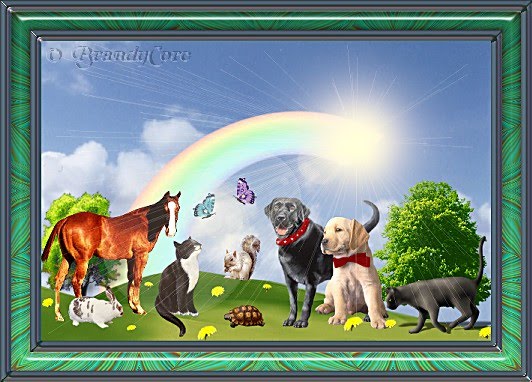
So it happened one afternoon that I was relaxing with a companion and enjoying the fruits of a full cable package when we came upon an astonishing documentary about the lives of Ferret Enthusiasts. The documentary in question mainly focused upon the intricate costumes these enthusiasts design for their weaselly urine be-stenched life partners and the trials and tribulations undergone by those daring enough to enter into the nation's largest competitive Ferret Show, but in and amongst this information was lodged a fascinating tidbit regarding a belief in a sub-realm of Heaven where one's dead pets go to wait for their owners souls to ascend. This is the eponymous Rainbow Bridge.


As a critical thinker, this concept raises many questions. Such as, is there any criteria for the allowance of these animals under the rainbow bridge? Do bad dogs, evil ferrets, malicious macaws, and horses that kicked their owners to death all reside along side the Just and Virtuous Pets? (aside: how did those butterflies get in? Don't tell me those were someone's pets, or that they had any moral concept whatsoever) Are goats or black cats allowed at all, being as they are the emissaries of Satan? Or is there a counterpart to the Rainbow Bridge located at the entrance to Hell? And what of those who's pets follow the doctorines of God above but themselves live lives of base sinfulness? Do they descend into Hell pulling their holy pets down from the rainbow bridge with them to the torments of Hell? Like many of the appendices of the afterlife, this Rainbow Bridge looks to be at the very least, an administrative nightmare for some poor low level bureaucratic Elohim.

The curious may click here for more information (and a midi composition of that song from Ghost and every wedding reception ever)

Friday, February 25, 2011

One Needs Never Be Over Smoked Again

In Which a Surprise is Had, and Consequent Revelations Are Dealt With

I consider my self a bastion of masculinity. Among my many facets and skills that I have both been blessed with by God above and have acquired with some strength of character through the years would be my masteries of falconing, rock identification, navigation by the stars, assembly language (the higher level languages being fit only for those both weak of heart and character), my keen eye with a hatchet, twine haggling (as my father would say, only Women and Lutherans over pay for twine), horse breeding, and the preparation of the Staff of Life itself by hand. The most prized of which I must say exemplarizes the attributes of the rugged sex is my steadfast dedication to "putting away" not less than One pack of Marlboro Full Flavor cigarettes per day. Thus it has come as a shock to discover that this rugged brand began it's course by courting the favor of the domestic house wife.


As Mild as May indeed! I must say that in the inhalation of the Full Flavored Marlboro I find nothing mild or spring like. Indeed the experience is delightfully harsh and invigorating to such a degree that it is like standing upon the precipitous lip of a volcano nearing it's eruption whilst being surrounded by musket men emptying their barrels. I can only theorize that the visceral and brutal thrill of the Marlboro proved to be too much for these poor housewives, with the intense exhilaration resulting in symptoms of Moral Fatigue. It is a boon for our culture that Philip Morris himself realized the degree of his mis-step and rightfully rerouted the course of his signature brand. One can only imagine the world of gravelly throated housewives fist fighting in the aisles of the green grocer, nursing their children while bare back horse riding, and splitting their own wood for use in the hearth-fires that may have resulted.

Thursday, February 24, 2011

In the Interest of Generating "Paddywhacks."

In Which a Pandering is Proposed; Hopefully Resulting in Arousal of Interests Both Dionysian and Apolline.

In my years of mortal existence, nearly half of which have been during this "Inter Net Age," I have come to the conclusion that there is one and only one guaranteed method of attracting visitors to ones web page(what in the local parlance are called "hits" or "paddywhacks"), and that is by way of Smut. Not the discolored fungus that grows upon forgotten corn in the winter and was enjoyed as a delicacy amongst the Aztecs, but the sort of generally disreputable tomfoolery involving all manner of engorged orifices and phalli juxtaposed in manners intended to distract the plebian in his navigations. I would fain prey upon this weakness of men in the interest of obtaining a wider audience who I may then educate in such a way as to assist them in someday abstaining from the urges generated by the primal cerebellum. Such forthcoming treatises include subjects as varied as gravures and foxing, generating logarithmic spirals with pen and paper, the subtle dissonances of Charles Ives lesser known compositions for piano duets, and preparing the well balanced and soothing Rye Whiskey Manhattan. Bide thy time and cast not your accusations of "Foul Pornographer" upon me, for verily I shall not resort to the crude anatomical photography as drearily common place on this Inter Net as the cellophane bags of chemically enhanced potato leavings are upon the dry goods shelves of your local green grocer. No, I pray that if this web site is to be utilized in the interest of Exhilarations of a physical nature, then let it generate only the most refined and genteel of tumescences. So let us now turn to that noted Man of Letters and Pervert, D. H. Lawrence for some minor titillations.

"She dropped her blanket and kneeled on the clay hearth, holding her head to the fire, and shaking her hair to dry it. He watched the beautiful curving drop of her haunches. That fascinated him today. How it slowed with a rich downslope to the heavy roundness of her buttocks! And in between, folded in the secret warmth, the secret entrances!
He stroked her tail with his hand, long and subtly taking in the curves and the globe-fulness...he exquisitely stroked the rounded tail, till it seemed as if a slippery sort of fire came from it into his hands. And his fingertips touched the two secret openings to her body, time after time, with a soft little brush of fire...With quiet fingers he threaded a few forget-me-not flowers in the fine brown fleece of the mount of Venus.
She looked down at the milky odd little flowers among the brown maiden-hair at the lower tip of her body.
'Doesn't it look pretty!' she said.
'Pretty as life,' he replied."


Glory be to God, what an excerpt! I respectfully Thank you for perusing this post, and invite you to share this small ray of enlightenment amongst your co horts at whatever bullitin board server you prefer to patronize in your typical co-minglings of inane animal photography and heavily photo shopped portraits of pudenda.